
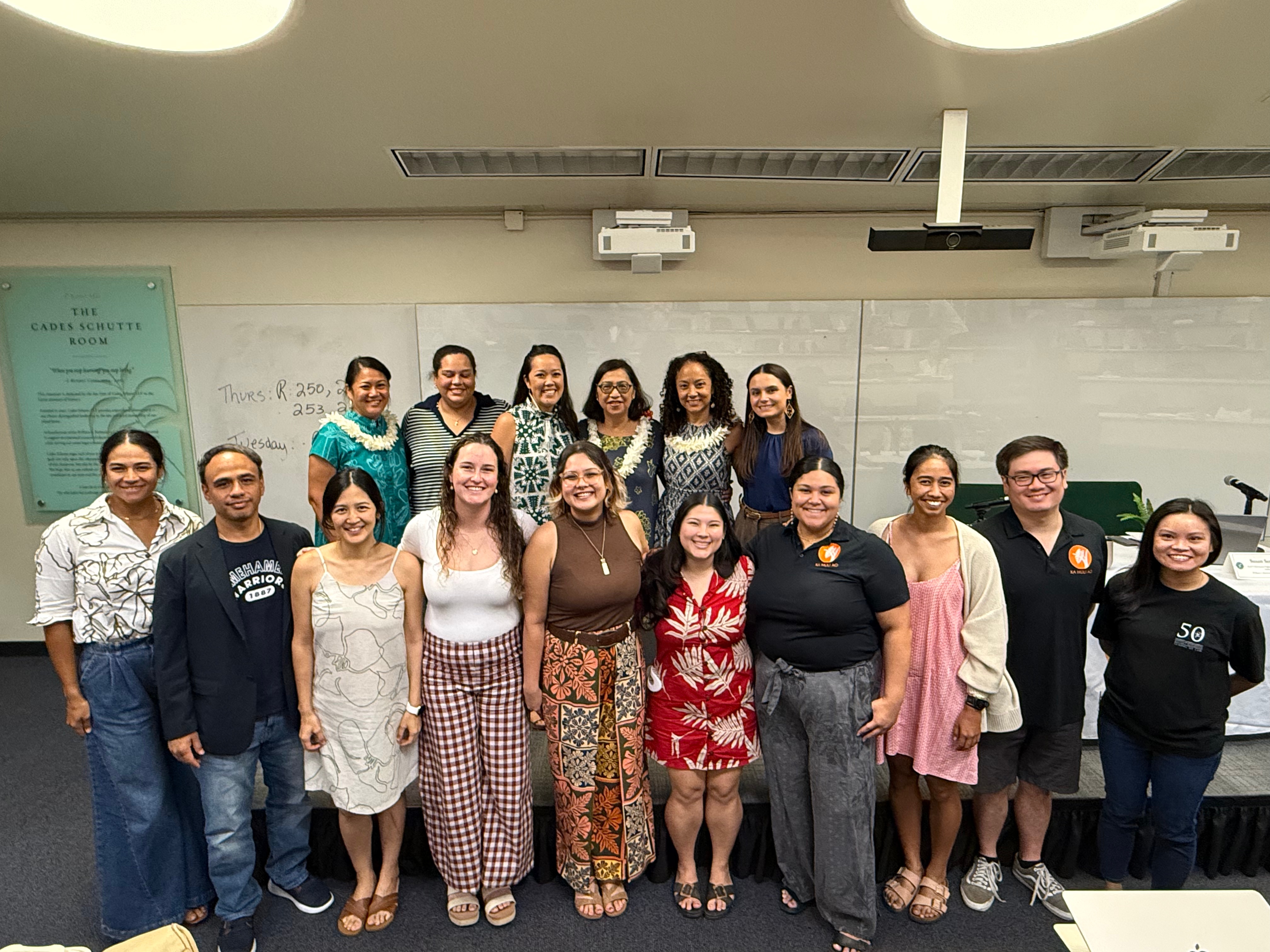
On November 6, Professor Susan Serrano ‘98 moderated the Maoli Thursday panel Surviving Doe: Understanding Threats to Kamehameha, Hawaiʻi, and Beyond. Featuring William S. Boyd School of Law Professor Addie Rolnick and Councilmember Esther Kiaʻāina, the panel examined the legal and political implications of the recent lawsuit, Students for Fair Admissions v. Trustees of the Estate of Bernice Pauahi Bishop (D. Haw. 2025), which challenges the Kamehameha Schools’ long-standing admissions policy and the legacy of Princess Bernice Pauahi Bishop.
In 1883, Princess Pauahi, aliʻi of the then-sovereign Hawaiian Kingdom, executed her final kauoha (will), establishing a charitable trust that dedicated her estate to the education and advancement of Native Hawaiian people across all islands. She acted during a period of profound upheaval marked by population loss, suppression of ʻŌlelo Hawaiʻi, and systematic dismantling of Indigenous self-governance due to western encroachment. Critically, Pauahi’s trust was a restorative act—an expression of ea (self-determination) and lāhui renewal—intended to uplift Native Hawaiians, not to exclude others. The founding of Kamehameha Schools in 1887, and its admissions policies, must be understood within this historical and legal context, reflecting Pauahi’s wish to uplift and strengthen the descendants of Hawaiʻi’s Indigenous People.
Professor Serrano highlighted similar arguments from Doe v. KS (9th Cir. 2006), where challengers claimed the policy constituted racial discrimination under 42 U.S.C. §1981. The Ninth Circuit, however, recognized that Kamehameha School’s mission is rooted in the unique legal and political history of Native Hawaiians and serves a remedial purpose tied to Native Hawaiian self-governance. The policy should not be reduced to a “racial preference” but understood as part of a broader Indigenous right to cultural continuity and educational self-determination—an approach consistent with recognition of Indigenous political status in cases such as Morton v. Mancari (1974).
Professor Rolnick situated the current case within a national movement to redefine equality through a narrow “colorblind” lens, culminating in the U.S. Supreme Court’s decision in Students for Fair Admissions v. Harvard (2023), which eliminated race-conscious admissions in higher education. She explained that the same organizations behind that litigation are now attempting to apply these arguments to Indigenous contexts, despite fundamentally different historical and legal foundations. These efforts threaten not only Kamehameha Schools, but the ability of Indigenous Peoples to maintain cultural survival within U.S. legal structures.
Councilmember Kiaʻāina emphasized the broader stakes: dismantling Kamehameha School’s policy could imperil other Native Hawaiian institutions, including the Office of Hawaiian Affairs, the Department of Hawaiian Home Lands, and federal Native Hawaiian programs. She highlighted the enduring significance of the 1993 Apology Resolution, in which the U.S. formally acknowledged its role in the illegal overthrow of the Hawaiian Kingdom and underscored the obligation to pursue reconciliation and redress historical injustices.
The panel concluded with a call to strengthen ʻike (knowledge), seek dismissal of the lawsuit, and foster political unity across the lāhui. Protecting Native Hawaiian rights requires advocacy not only in Hawaiʻi but also in national legal and policy arenas, ensuring the survival of our people, ʻāina, and future.
 Ka Huli Ao