
Ka Huli Ao conducts cutting-edge research and produces unique scholarship that advances Native Hawaiian law, facilitates legal learning, and impacts the Native Hawaiian community. Our research and scholarship incorporates history, culture, and present-day context to advance social justice for Native Hawaiians, Pacific and Indigenous Peoples, and all peoples.
Native Hawaiian Law: A Treatise
On August 2015, Ka Huli Ao released Native Hawaiian Law: A Treatise, the definitive resource for understanding critical issues affecting Native Hawaiians.
This extensively updated and revised edition of the groundbreaking 1991 Native Hawaiian Rights Handbook offers a comprehensive overview as well as analysis of specific topics within this complex area of law. Native Hawaiian Law: A Treatise is a collaborative effort of the Native Hawaiian Legal Corporation, Ka Huli Ao Center for Excellence in Native Hawaiian Law at the William S. Richardson School of Law University of Hawai‘i at Mānoa, and Kamehameha Publishing.
Native Hawaiian Law: A Treatise is the definitive resource for understanding critical legal issues affecting Native Hawaiians. Some of the specific topics covered include:
- Native Hawaiians and U.S. Law
- Native Hawaiians and International Law
- The Public Land Trust
- Water Rights
- Traditional and Customary Access and Gathering Rights
- Burial Rights
- The Hawaiian Homes Commission Act
- The Island of Kahoʻolawe
- Indigenous Cultural Property
- Native Hawaiian Health
- Hawaiian Language and Education
- And much more
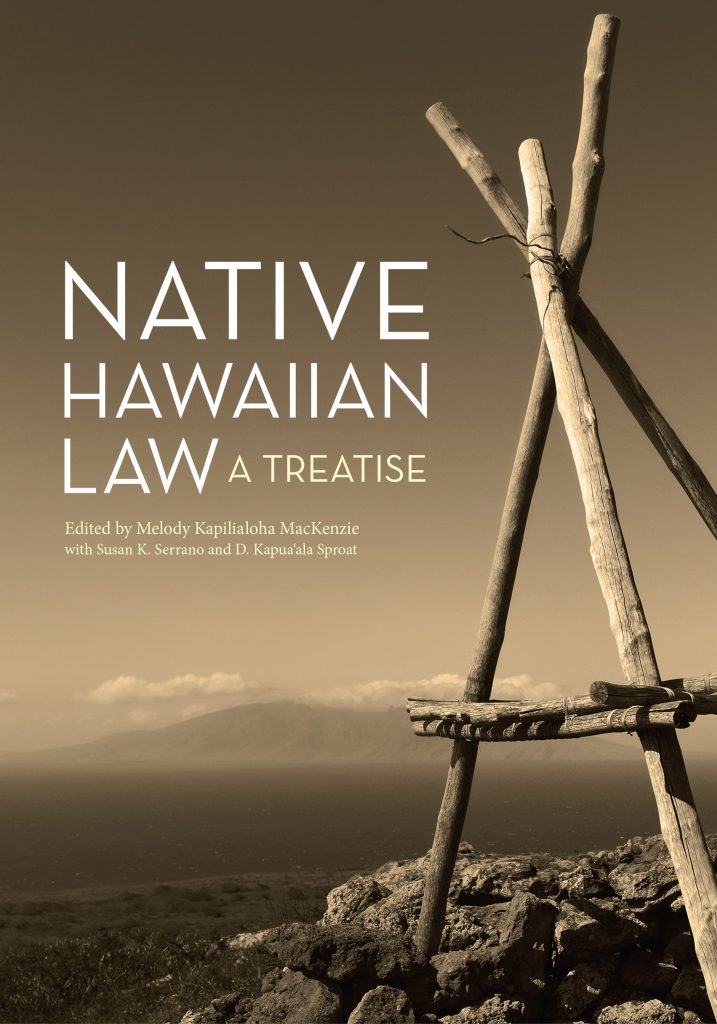
Native Hawaiian Law: A Treatise provides the tools to find relevant cases, statutes, and regulations impacting the rights of Native Hawaiians. It focuses on the relationship between Native Hawaiians and the state and federal governments; trust lands; vital areas of resource protection and management; protection of burials, repatriation, language, education, and health; and emerging human rights norms affecting Indigenous Peoples. This in-depth guide is an essential addition to the growing body of scholarship on Indigenous Peoples’ law.
WAIWAI: Water and the Future of Hawaiʻi
Professor Sproat’s chapter: Reframing Wai as Waiwai: The Public Trust as Paradigm in Hawaiʻi Nei, was co-authored with Mahina Tutuer. It details Hawaiʻi’s legal regime, including its origins in Native Hawaiian custom and tradition and aloha ʻāina in particular. It also focuses on the re-emergence of Hawaiʻi’s public trust through the jurisprudence of Chief Justice William S. Richardon. The chapter centers the work of the Native Hawaiian Rights Clinic in Waiʻoli Kauaʻi, and how Kānaka precepts and biocultural knowledge have been deployed as a basis for decisionmaking by the Water Commission under the leadership of Native Hawaiian commissioners and deputies.
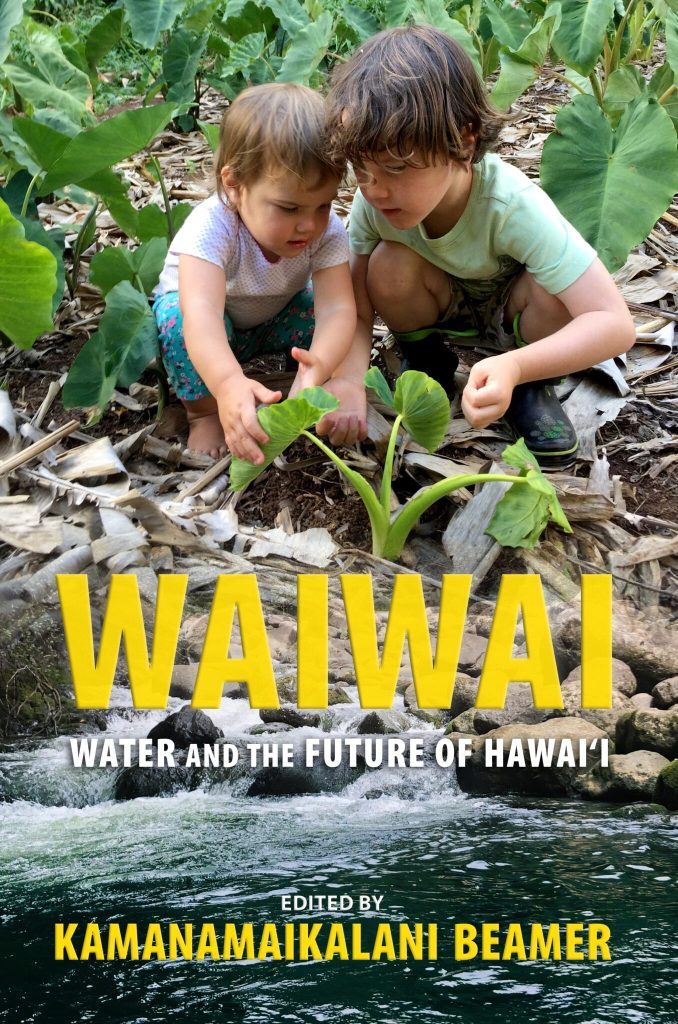
In April 2025, we celebrated the publication of Professor Kamanamaikalani Beamer’s book Waiwai: Water and the Future of Hawaiʻi! This compilation is a groundbreaking exploration of water in these islands that bridges ancestral place-based knowledge with present challenges faced by community members, cultural activists, academics, scientists, and policymakers alike. Professor Beamer gathered experts from diverse fields with critical knowledge of the current status of water and wealth in Hawaiʻi. Indigenous scholars recount ancestral abundance and how traditional water management principles and values were impacted by colonial interests. Legal scholars unpack the web of water rights and regimes, while scientists provide the latest knowledge needed to guide our path forward in this time of climate uncertainty. In his review, Dr. Cornel West proclaimed: “This profound and prophetic book is the definitive treatment of the philosophical, historical, and political dimensions of the future of Hawaiʻi. Water, wealth, and the well-being of the precious inhabitants of the islands sit at the center of this monumental text. We ignore its painful truths at our peril!”
As Hawaiʻi ponders our water future, the public trust can and should play a pivotal role. Utilized to its fullest extent, the public trust could be the most important tool for water resource management – and resource management period – in Hawaiʻi nei. This chapter explores the public trust as paradigm, and its potential to bend the moral universe towards justice for Kānaka Maoli and all who call our islands home.
Legal Primers in Native Hawaiian Law
These legal primers provide community-oriented introductions to laws governing iwi kūpuna (ancestral bones), traditional and customary rights, water, and quiet title. They are designed to summarize major laws and issues, and direct those with additional questions to available resources.
Although these primers are intended to provide helpful information, they are not substitutes for and do not provide individualized legal advice. If you have legal questions, please consult an attorney who specializes in these areas of law. These primers were printed with funding from the Office of Hawaiian Affairs.
Hoʻi Hou I Ka Iwikuamoʻo: A Legal Primer for the Protection of Iwi Kūpuna in Hawaiʻi Nei
Hoʻohana Aku, a Hoʻōla Aku: A Legal Primer for Traditional and Customary Rights in Hawaiʻi
Ola i ka Wai: A Legal Primer for Water Use and Management in Hawaiʻi
E ʻOnipaʻa i Ke Kulāiwi: A Legal Primer for Quiet Title and Partition Law in Hawaiʻi
Select Scholarship
Intersectional Imperial Legacies in the U.S. Territories (Susan K. Serrano)
Professor Susan K. Serrano published Intersectional Imperial Legacies in the US Territories, exploring how U.S. colonialism has inflicted disproportionate and intersectional harms on women and people who can become pregnant in the U.S. territories. Professor Serrano identifies two key forms of injustice—reproductive oppression and economic exclusion—driven by limited access to healthcare and public benefits. Critically, her article reframes territorial residents’ “political powerlessness” as a continuing legacy of colonial subjugation and proposes a more robust rational-basis-with-bite standard—one that considers the cumulative nature of harm and calls on courts to address how race, gender, poverty, and colonization reinforce political exclusion.
Ola i ka Malu ʻUlu o Lele: An Emerging Collective Memory of Injustice in Maui Komohana as a Foundation for Recovery from Lahaina’s Wildfires and Restorative Justice for Hawaiʻi (A. Uʻilani Tanigawa Lum)
In Ola i ka Malu ʻUlu o Lele: An Emerging Collective Memory of Injustice in Maui Komohana as a Foundation for Recovery from Lahaina’s Wildfires and Restorative Justice for Hawaiʻi, Assistant Professor A. Uʻilani Tanigawa Lum examines how colonial narratives justify decades of dewatering wrought by plantation-era ditch systems, which diverted water for industrial agriculture, tourism, and luxury housing in Maui Komohana—developments that have fueled recurring fires throughout Maui Komohana. She highlights how, in the wake of the August 2023 wildfires, communities across Hawaiʻi pae ʻāina have denounced dominant narratives that frame traditional and customary uses of water as the problem through moʻolelo, mele, hula, and legal advocacy. “E Hoʻi ka Nani”—let the glory return—is a call to reaffirm the Native-centered collective memory of injustice emerging in Maui Komohana today.
The Role of Human Rights in Advancing Justice for Native Hawaiians: Infusing Indigenous Human Rights with Kanaka Maoli Values (Derek H. Kauanoe)
Assistant Professor Derek H. Kauanoe’s article, The Role of Human Rights in Advancing Justice for Native Hawaiians: Infusing Indigenous Human Rights with Kanaka Maoli Values, critiques Act 236 for failing to protect Native Hawaiian rights, particularly by authorizing the state to extend certain 65-year public land leases for an additional 40-years. Kauanoe’s analysis demonstrates how Act 236 perpetuates land dispossession, severs cultural connection to land and resources, and undermines Native Hawaiians’ right to self-determination by excluding them from critical decision-making. Kauanoe assesses Act 236’s impact through a restorative justice framework that integrates international human rights norms with four interconnected Kanaka Maoli values: moʻomeheu (cultural integrity), ʻāina (land and natural resources), mauli ola (social determinants of health and well-being), and ea (self-governance).
Farrington v. Tokushige: Language and Power in Hawaiʻi (MJ Palau-McDonald)
Assistant Professor MJ Palau-McDonald published Farrington v. Tokushige: Language & Power in Hawaiʻi in a symposium issue of Western Legal History, the journal of the Ninth Judicial Circuit Historical Society. In the essay, she reinserts the significant racial dynamics that undergirded the events, cultural depictions, and legal justifications for the school control legislation at issue in Tokushige that were lost in the U.S. Supreme Court’s sterilized decision.
 Ka Huli Ao