
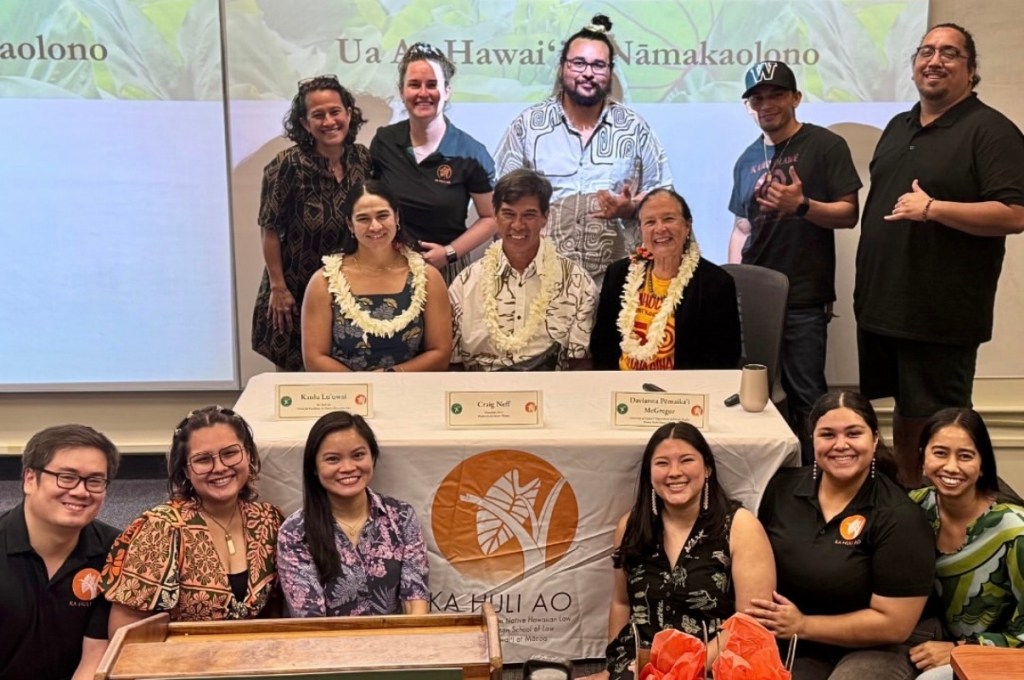
On March 5, 2026, the Ka Huli Ao Center for Excellence in Native Hawaiian Law hosted Maoli Thursday Nāmakaolono: 50 Years of Aloha ʻĀina and Law Through Kahoʻolawe, reflecting on a half-century of struggle to protect and restore the island of Kahoʻolawe. Moderated by Post-JD Legal Fellow and Protect Kahoʻolawe ʻOhana (“the ʻOhana”) member Kaulu Luʻuwai (‘21), the panel featured longtime ʻOhana kua (leaders) Craig Neff and Professor Emerita Davianna Pōmaikaʻi McGregor. Together, they discussed how cultural protocol, grassroots organizing, and strategic litigation converged to shape a movement grounded in laʻa, paʻa, maʻa—a process of sanctifying, sustaining, and ultimately becoming deeply familiar with the land.
On January 4, 1976, activists including George Helm and Emmett Aluli landed on Kahoʻolawe to protest the illegal overthrow of the Hawaiian Kingdom in defiance of the U.S. Navy’s decades-long bombing of the island. That act ignited a statewide movement to stop the bombing and restore the island.
Stopping the bombing at Kahoʻolawe began with becoming laʻa—through cleansing and protocol. To become laʻa, on February 13, 1976, kūpuna including Aunty Emma De Fries and kahuna Sam Lono conducted a ceremony on Kahoʻolawe to cleanse the island and ask permission from the island and its spirits before stewardship began. Kūpuna further advised the ʻOhana to organize as a spiritually-grounded extended family rather than a conventional nonprofit, rejecting hierarchical titles and embracing intergenerational leadership. The island itself was treated not as property but as a living relative—something to care for and nurture back to health.
Soon after, the movement became maʻa. As the struggle intensified, Dr. Noa Emmett Aluli and the ʻOhana turned to the federal courts, filing Aluli v. Rumsfeld, a landmark lawsuit that combined environmental law, cultural protection, and civil rights claims. The case alleged violations of several federal statutes, including the National Environmental Policy Act, the Federal Water Pollution Control Act, the Marine Protection, Research, and Sanctuaries Act, and the Endangered Species Act. The federal court ultimately found multiple violations of environmental and historic preservation law, issuing an injunction that halted further live-fire training until environmental compliance was achieved.
The consent decree that followed required environmental impact statements, limited the Navy’s use of live ordnance, established a joint governance structure recognizing the ʻOhana as stewards of the island, and granted the ʻOhana regular access for cultural, educational, and restoration work. The court also acknowledged religious access under the American Indian Religious Freedom Act—an important acknowledgement that Native Hawaiian spiritual practice is inseparable from place. These legal victories helped pave the way for later milestones, including the Navy’s cessation of bombing in 1990 and the 1992 transfer of Kahoʻolawe to the State of Hawaiʻi to be held in trust for a future Native Hawaiian governing entity.
In light of these critical legal victories, the panel emphasized that the law alone did not lead to the bombing being stopped and its eventual release from military control. The panel recognized that national politics and public pressure played intertwined and invaluable roles in the ʻOhana’s success. Moreover, the panel underscored the importance of the ʻOhana’s unrelenting will to establish residence at Hakioawa on the island’s north shore, demonstrating its commitment as kamaʻāina to Kahoʻolawe. Through consistent presence, the ʻOhana has facilitated safe huakaʻi (trips) for more than 50,000 volunteers to clear invasive species, replant native species, revive Makahiki ceremonies and other ʻaha (ceremonies) and learn about Kahoʻolawe’s significant historical and cultural sites. Through repeated journeys to the island, participants learn to become maʻa—to develop deep familiarity with Kahoʻolawe through kilo, careful observation of winds, rains, and seasons, and the knowledge embedded in moʻolelo, place names, and chant.
Craig Neff reminded students that meaningful change requires what he calls the five P’s of movement building: pule, politics, persistence, protest, and sometimes a metaphorical punch. Prayer grounds the work; politics and protest push systems to change; persistence sustains a movement that can span generations. All of it, he emphasized, must be carried out with kapu aloha. Professor McGregor offered complementary guidance for future lāhui lawyers: do your research, think creatively, and trust both your instincts and ʻike kūpuna.
The ʻOhana’s work over the last fifty years since the first landings to stand up to the U.S. military set the precedent for land back, and cultural and environmental restoration. The panel reminded those gathered, however, that the work of aloha ʻāina is not pau yet!
 Ka Huli Ao