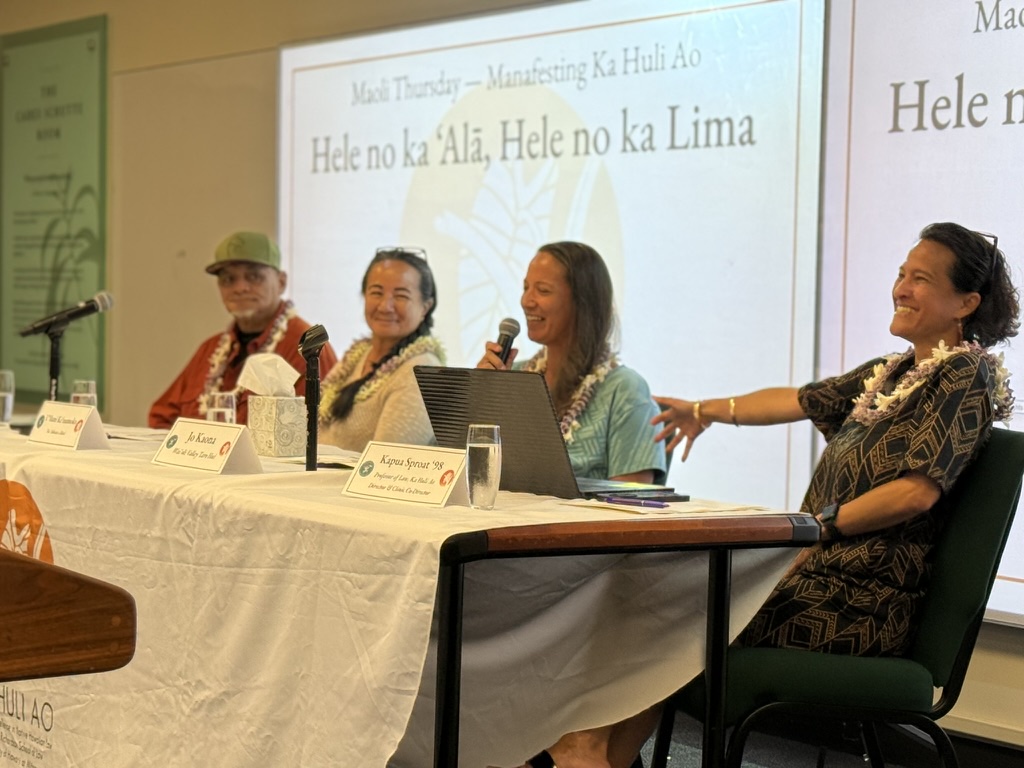
On April 3, Professor Kapua Sproat ʻ98 moderated the final Maoli Thursday of the 2024–25 academic year, Hele no ka ʻAla, Hele no ka Lima: Past and Present Work in the Native Hawaiian Rights Clinic. The panel featured Keʻeaumoku and Uʻilani Kapu of Nā ʻAikāne o Maui and JoAnne Kaona of Waiʻoli Valley Taro Hui. From the loʻi of Waiʻoli on Kauaʻi to the valley of Kauaʻula in Maui Komohana, panelists shared how the Clinic’s work creates ripples across our pae ʻāina—supporting communities as they navigate permits, shape legislative policy, and protect wai, ʻāina, and culture through non-litigation legal advocacy grounded in local expertise.
In Waiʻoli—where a significant portion of Hawaiʻi’s kalo is cultivated—Ka Huli Ao’s Clinics supported the community’s recovery after the 2018 rain bomb by assisting with nonprofit formation, securing a permanent easement for the Hui’s manowai, and helping to pass Act 27, which exempts traditional kalo cultivation from the water leasing provisions of Hawaiʻi Revised Statutes 171-58. This effort was uplifted as an example of community-driven collaboration between community, state, and federal partners. In Maui Komohana—where private interests control nearly 75% of water—the Native Hawaiian Rights Clinic has supported community members in applying for water use permits, navigating government processes, restoring historic waterways, and advocating before the Commission on Water Resource Management.
The Clinic’s approach to lāhui lawyering emphasizes working with, not for, communities—co-powering those already doing the hardest work on the ground: kalo farmers, cultural practitioners, and generational land stewards. Much of this work intersects with water, as Uʻilani Kapu, shared, “Without wai, we don’t exist. We don’t have a future.” Her poignant words were a reminder that this work is not only legal, but is also spiritual, cultural, and generational.
 Ka Huli Ao