
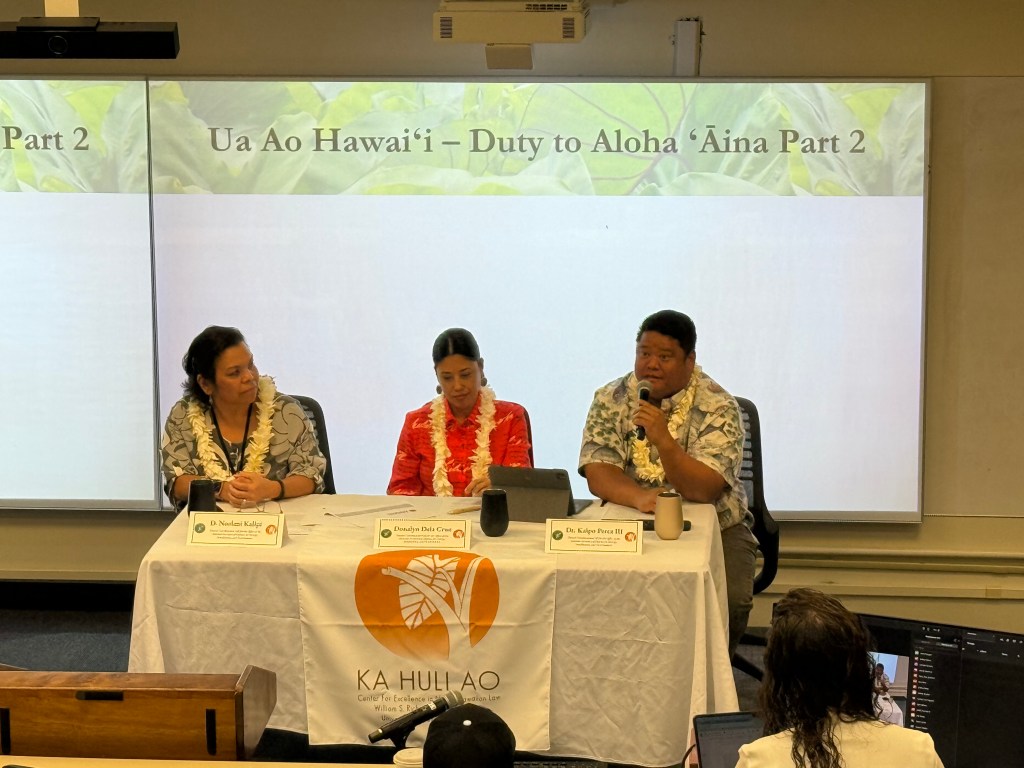
On February 5, 2026, Ka Huli Ao hosted “Maoli Thursday Ua Ao Hawaiʻi: Duty to Aloha ʻĀina, Part II,” convening a panel on the future of military leases on Hawaiʻi’s Public Land Trust ʻāina. Moderator D. Noelani Kalipi was joined by Donalyn Dela Cruz and Dr. Kaipo Perez III, members of the Hawaiʻi Coordination Cell for the Office of the Assistant Secretary of Defense for Energy, Installations, and Environment.
Established in 2024, the Hawaiʻi Coordination Cell serves as the Department of War’s dedicated office in Hawaiʻi, aligning land use, energy, installations, environmental planning, and real estate decisions with both national security requirements and community needs. Panelists described the office as a direct line to the Pentagon intended to improve communication and accountability around decisions that deeply affect local communities.
Kalipi kicked off the discussion with an overview of the scale of the military’s footprint in Hawaiʻi. As headquarters for the Indo-Pacific Command (the military’s largest area of operations), Hawaiʻi remains a focal point of U.S. defense strategy. Modern defense planning now extends beyond traditional training grounds to include cyber, satellite, and space-based systems, making a sustained military presence likely for the foreseeable future. Given this reality, panelists emphasized that Hawaiʻi’s people should play a stronger role in shaping how that presence is structured and governed.
The discussion centered on expiring leases, particularly at the Pōhakuloa Training Area on Hawaiʻi Island, where the Army’s 65-year lease of approximately 23,000 acres of state-owned land is set to expire in 2029. Although the Army cleared federal environmental review under the National Environmental Policy Act (“NEPA”), the state Board of Land and Natural Resources rejected the Final Environmental Impact Statement under the Hawaiʻi Environmental Policy Act (“HEPA”). Without state approval, the Army cannot simply renew the lease and must consider alternatives such as revised agreements, easements, land exchanges, purchases, or, as a last resort, eminent domain. Some parcels were acquired in fee simple and could be considered for a land exchange.
Panelists distinguished between “warfighter” functions and “installations” of the military’s dual roles. While warfighters focus on readiness across land, sea, air, and space, installations function more like municipalities, managing housing, infrastructure, utilities, environmental compliance, and land management. Together, these uses encompass more than 221,000 acres statewide, largely on Public Land Trust ʻāina.
The discussion centered on expiring leases, particularly at the Pōhakuloa Training Area on Hawaiʻi Island, where the Army’s 65-year lease of approximately 23,000 acres of state-owned land is set to expire in 2029. Although the Army cleared federal environmental review under the National Environmental Policy Act (“NEPA”), the state Board of Land and Natural Resources rejected the Final Environmental Impact Statement under the Hawaiʻi Environmental Policy Act (“HEPA”). Without state approval, the Army cannot simply renew the lease and must consider alternatives such as revised agreements, easements, land exchanges, purchases, or, as a last resort, eminent domain. Some parcels were acquired in fee simple and could be considered for a land exchange.
Panelists underscored the importance of meaningful dialogue, noting that communities bring historical memory, cultural knowledge, and lived experience, while the military contributes operational and security perspectives. Even amid persistent disagreement, shared facts and transparent processes can support more informed decision-making.
Trust remains a central challenge. From the overthrow of the Hawaiian Kingdom to decades of live-fire training, contamination, and restricted access, military occupation has left lasting harm across the pae ʻāina. Environmental concerns at sites like Pōhakuloa, including unexploded ordnance, toxic chemicals, PFAS, and depleted uranium, continue to fuel public skepticism. Although federal and state laws require cleanup, compliance has often lagged. Panelists acknowledged the need for stronger oversight and clearer commitments. For those who care about ʻāina and the Public Land Trust, participation through testimony, comments, and public process is critical.
 Ka Huli Ao