
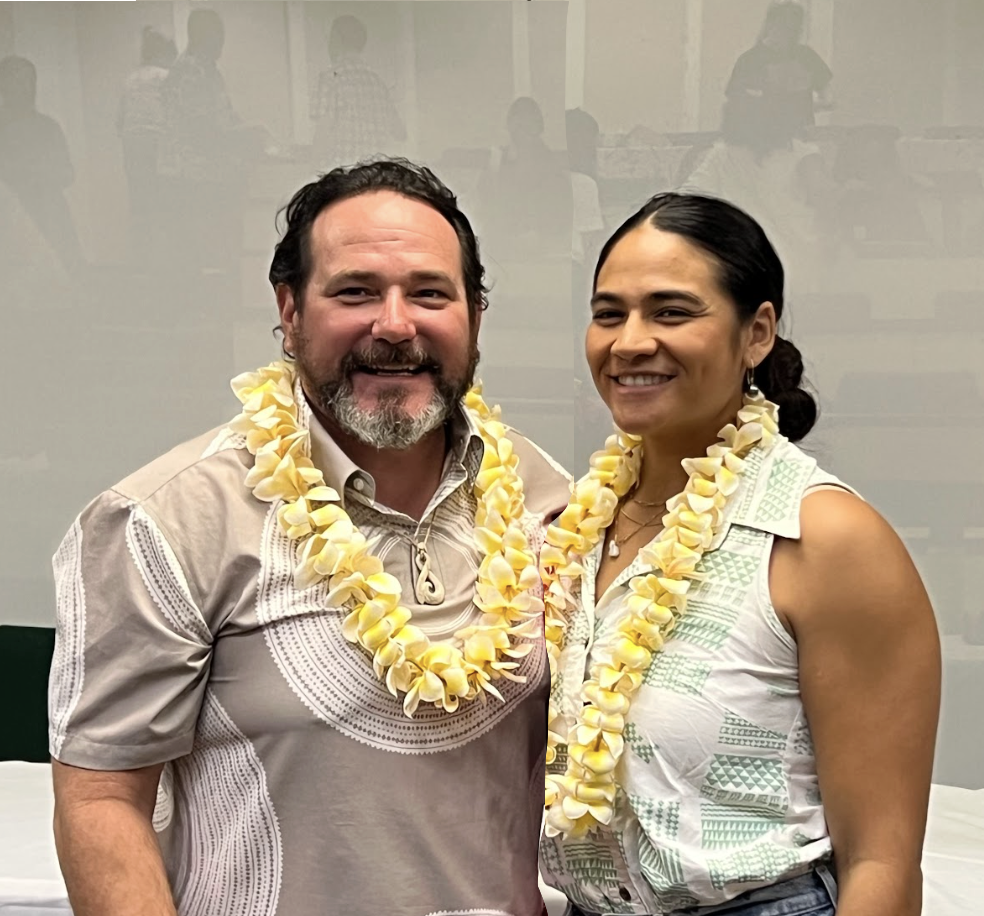
On February 6, 2025, Ka Huli Ao’s hosted a Maoli Thursday panel, ‘Ōlelo Hawaiʻi in the Law, featuring scholars Dr. Kamanamaikalani Beamer and Post-J.D. Legal Fellow Kaulu Luʻuwai ‘21. The panelists discussed how ʻōlelo Hawaiʻi is foundational for legal research and scholarship in Hawaiʻi, as it grounds the law in Hawaiian cultural values and empowers Kānaka to reclaim their identities and assert their rights.
Luʻuwai illustrated this point by quoting Khaled Hosseini, “[I]f culture was a house, then language was the key to the front door, to all the rooms inside. Without it . . . you ended up wayward, without a proper home or a legitimate identity.” Just as a key unlocks the rooms of a house, fluency in ʻōlelo Hawaiʻi reveals a deeper understanding of the world through Kānaka perspectives, enabling scholars to engage with the true meaning of language, history, and law. For much of Hawaiʻi’s history, legal analysis has relied on western frameworks, often by scholars unfamiliar with ʻōlelo Hawaiʻi, resulting in misinterpretations of primary sources and distortions of traditions and customs. Without proper contextualization, legal scholarship—and broader knowledge—risks being disconnected from the lived experiences, traditions, and values that shape Hawaiʻi’s legal landscape.
The discussion emphasized how a deeper understanding of ʻōlelo Hawaiʻi can strengthen legal frameworks, such as the public trust doctrine, by giving concepts like aloha ‘āina enforceable weight in guiding resource stewardship, as explored in The Duty to Aloha ʻĀina: Indigenous Values as a Legal Foundation for Hawaiʻis’ Public Trust by Professors D. Kapuaʻala Sproat ‘98 and MJ Palau-McDonald ‘22. The panelists emphasized that ʻōlelo Hawaiʻi is more than a language—it is a way of seeing and understanding relationships between people, land, and water, through an Indigenous framework. They noted that the nuanced meanings embedded in the language reveal deeper obligations of care and reciprocity that might otherwise be lost in English translations without proper context. Dr. Beamer cautioned against misusing or oversimplifying Hawaiian terms in legal contexts, highlighting how historical power imbalances have led to the selective appropriation of Hawaiian terms by those who do not fully grasp their depth. The panelists urged law students and practitioners to engage with ʻōlelo Hawaiʻi thoughtfully, not only as a language but as a legal framework that embeds Hawaiian cultural tenets into law, so that Hawaiʻi’s legal regime continues to reflect and sustain the knowledge and values that have shaped the paeʻāina for generations.
 Ka Huli Ao